TL;DR
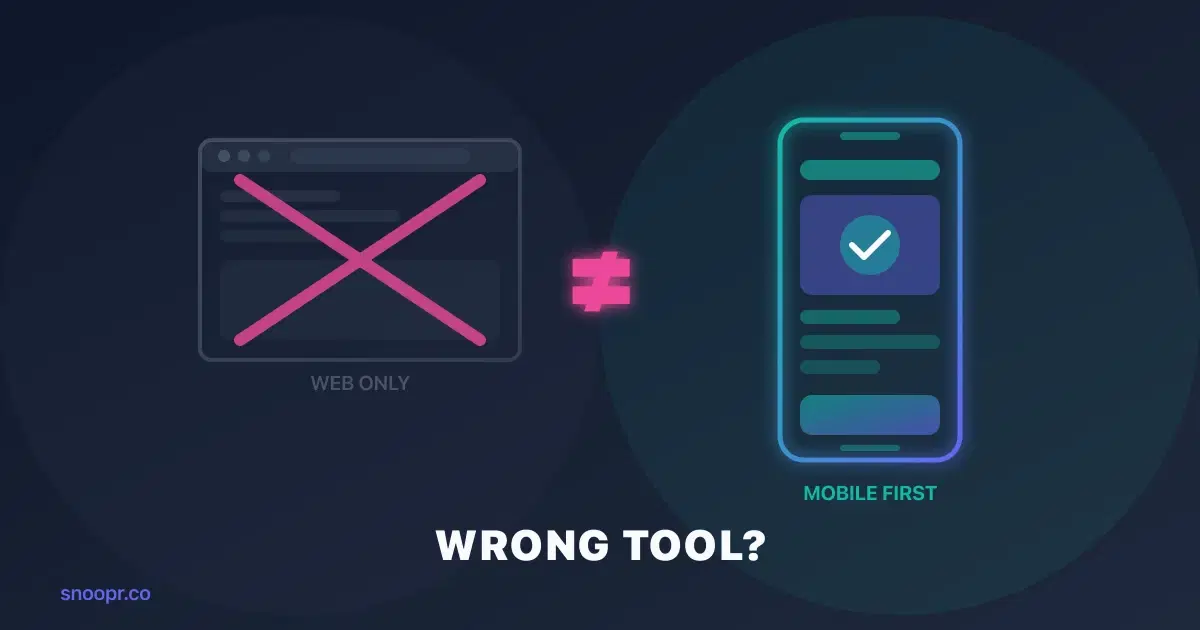
Chameleon: Excellent for web apps. But Chameleon doesn't support native mobile apps at all—no mobile SDK exists. If your product is a mobile app, Chameleon isn't an option.
Snoopr: Built exclusively for mobile from day one. $59/month for 3 apps. AI generates your onboarding flows in seconds. Figma-like visual builder gives you pixel-perfect control. Instant publishing without app store reviews.
The bottom line: Chameleon and Snoopr serve different platforms entirely. Chameleon dominates web onboarding. Snoopr dominates mobile onboarding.
Key Points
- Chameleon does not support native mobile apps—their platform is designed exclusively for web applications that run in browsers
- Snoopr was purpose-built for React Native mobile apps, with a lightweight SDK, AI content generation, and instant publishing
- If you've been evaluating Chameleon for mobile onboarding, you're looking at the wrong category of tool entirely
The Search That Led You Here
You're probably here because you've heard good things about Chameleon.
Maybe a colleague recommended it. Maybe you saw it on a "best onboarding tools" listicle. Maybe you've used it successfully for a web product and now you're building a mobile app.
So you searched for "Chameleon mobile" or "Chameleon React Native SDK" or "Chameleon alternative for mobile."
And you discovered something frustrating: Chameleon doesn't do mobile.
From Chameleon's own help documentation:
> "At this time, Chameleon does not support native mobile applications. Chameleon is built for browser-based web applications and relies on JavaScript to show Experiences."
This isn't a knock on Chameleon. They've built an excellent web onboarding platform. Tours, tooltips, surveys, launchers—all polished, all effective, all browser-only.
But if your product is a mobile app, you need a different solution entirely.
Let me show you what that looks like.
Why Chameleon Doesn't Work for Mobile
Understanding why Chameleon can't support mobile apps helps explain why mobile-first tools like Snoopr exist.
Chameleon's architecture:
Chameleon injects JavaScript into your web application. When a user visits your site, Chameleon's script loads in the browser, detects elements on the page, and renders tours, tooltips, and modals on top of your existing UI.
This works brilliantly for web apps. Browsers are standardized environments. JavaScript runs everywhere. DOM manipulation is well-understood.
Why this doesn't translate to mobile:
Native mobile apps don't run in browsers. They're compiled binaries—Swift/Kotlin code packaged into executables that run directly on iOS and Android devices.
There's no DOM to manipulate. No JavaScript runtime (unless you're using React Native). No way to "inject" experiences the way web tools do.
To support mobile apps, you need a native SDK—purpose-built code that integrates with iOS and Android development frameworks. Chameleon hasn't built this.
Chameleon's workaround suggestion:
Chameleon's documentation suggests using their OneSignal and Zapier integrations to "sync Chameleon data and trigger messages and push notifications on mobile devices."
This isn't mobile onboarding. This is push notifications. Completely different use case, completely different user experience.
If you want in-app onboarding flows—welcome screens, feature tours, value proposition sequences, interactive walkthroughs—you need a mobile-native solution. That's exactly what Snoopr provides: a React Native SDK that renders onboarding flows natively inside your app, not external notifications that pull users out of their experience.
What Mobile Onboarding Actually Requires
Mobile onboarding is fundamentally different from web onboarding—and the stakes are higher. 25% of mobile apps are abandoned after a single use, and 77% of users never return after day one. The first 60 seconds determine whether users stick around or delete your app.
This is why mobile-specific tooling matters. Here's what you actually need:
1. Native SDK Integration
A lightweight SDK that installs in your iOS/Android/React Native codebase. It needs to be small (users hate bloated apps), fast (no startup lag), and reliable (offline handling, graceful degradation).
Snoopr's React Native SDK is ~2MB and installs in about 10 minutes.
2. Dynamic Content Delivery
The ability to update onboarding flows without submitting new app versions to the App Store or Google Play. This is the superpower that web tools take for granted—instant publishing—but it requires specific architecture for mobile.
Snoopr publishes to a global CDN. Your app's SDK fetches the latest onboarding configuration on launch. Change a headline, publish, and it's live immediately.
3. Mobile-Native UI Components
Elements designed for touch interactions, thumb-friendly tap targets, and the interaction patterns users expect on mobile. Not web components crammed into a mobile viewport.
Snoopr includes 20+ mobile-native element types: bubble pickers, card selects, image grids, toggle lists, star ratings, progress indicators—all designed for how people actually use phones.
4. A/B Testing Without App Store Delays
The ability to test onboarding variations without the 3-7 day App Store review cycle that normally gates every mobile change. Traditional mobile development limits teams to roughly 17 onboarding experiments per year. With instant publishing, that number jumps to 100+.
Snoopr's A/B experimentation runs server-side. Create variants, set traffic allocation, measure results—all without touching code or waiting for approvals. This is the competitive advantage that web teams have always had, now available for mobile.
Snoopr: Built for Mobile From Day One
Snoopr wasn't adapted from a web product. It was built exclusively for mobile apps from the first line of code.
Mobile-first architecture:
- React Native SDK designed specifically for mobile performance
- Content delivered via CDN, rendered natively on device
- Offline support with local caching
- No browser dependencies, no WebViews, no compromises
AI-powered content generation:
Describe your app in plain English. Snoopr's AI generates complete onboarding flows—screens, headlines, body copy, CTAs—in about 60 seconds. Not templates to fill in. Complete, ready-to-refine experiences.
This changes the math on mobile onboarding. Instead of spending half a day on a 5-screen flow, you get a strong first draft in minutes and spend your time refining, not creating from scratch.
Visual canvas builder:
A Figma-like design environment where you build exactly what you envision. Drag elements, position them precisely, preview on real device dimensions. No CSS. No code. No "close enough" template compromises.
Instant publishing:
Click publish. The changes are live immediately. Every user who opens your app sees the new onboarding flow. No App Store submission. No 3-7 day review. No waiting.
Feature Comparison: Chameleon vs Snoopr
| Feature | Chameleon | Snoopr |
|---|---|---|
| Platform Support | Web only | Mobile (React Native) |
| Native Mobile SDK | No | Yes |
| React Native Support | No | Yes (purpose-built) |
| iOS/Android Support | No (web only) | Yes (via React Native) |
| In-App Onboarding Flows | Web only | Mobile native |
| Visual Builder | Template-based | Figma-like canvas |
| AI Content Generation | No | Yes |
| A/B Testing | Yes (web) | Yes (mobile) |
| Custom Designs Without Code | Requires CSS | Never needs code |
| Publishing Speed | Instant (web) | Instant (mobile) |
| Offline Support | N/A (web) | Yes |
The comparison is stark because these tools serve different platforms entirely. Chameleon is excellent at what it does—web onboarding. But it doesn't do what you need if you're building mobile apps.
Pricing: Chameleon vs Snoopr
Even if Chameleon supported mobile (it doesn't), the pricing comparison favors Snoopr.
Chameleon Pricing (2026)
| Plan | Price | MTU Limit | Key Limitations |
|---|---|---|---|
| Demos Free | $0 | — | Interactive demos only, no tours/tooltips |
| Startup | $279/mo | Tiered | 6 seats, 1 launcher, 5 microsurveys |
| Growth | $12,000/year | Higher | A/B testing, unlimited experiences |
| Enterprise | Custom | Custom | Unlimited seats, localization |
Chameleon's Startup plan at $279/month doesn't include A/B testing. You need the Growth plan ($12,000/year = $1,000/month) to test variations.
Snoopr Pricing (2026)
| Plan | Price | MTU Limit | Apps | What's Included |
|---|---|---|---|---|
| Starter | $59/mo* | 10,000 | 3 | Full visual builder, AI generation, A/B testing, analytics |
| Growth | $149/mo* | 50,000 | 10 | Everything in Starter + unlimited flows, more AI generations |
*Billed annually (save 25%). 30-day free trial included.
Key difference: MTU vs MAU
Snoopr charges for Monthly Tracked Users—users who actually see your onboarding. Chameleon charges for Monthly Tracked Users too, but at 4-5x the price point.
For a team with 10,000 users seeing onboarding:
- Chameleon Startup: $279/month (no A/B testing)
- Snoopr Starter: $59/month (includes A/B testing)
Snoopr is 79% less expensive and includes features Chameleon gates behind higher tiers.
And remember: Snoopr uses MTU (Monthly Tracked Users)—you only pay for users who actually see your onboarding. If 50,000 users open your app but only 10,000 see onboarding flows, you pay for 10,000. This alone can reduce costs by 50-80% compared to MAU-based pricing.
When Chameleon Is the Right Choice
Let's be fair. Chameleon is an excellent tool for the right use case:
- You're building a web application — Chameleon's web onboarding is polished and full-featured
- You need tours, tooltips, and surveys in-browser — Their experience types are comprehensive
- You want deep integrations with web analytics — Chameleon connects to Segment, Amplitude, Mixpanel, and more
- You need enterprise compliance features — SOC 2 Type II, GDPR, CCPA certified
If your product is a web app and mobile is secondary or nonexistent, Chameleon deserves serious consideration. But if you have both web and mobile products, many teams use Chameleon for web and Snoopr for mobile—each tool excels at its respective platform.
When Snoopr Is the Right Choice
Snoopr is the right choice if:
- Your product is a mobile app — This is the fundamental qualifier. If you're building for iOS/Android, you need mobile-native tooling
- You're using React Native — Snoopr's SDK was purpose-built for React Native from day one
- You want AI to accelerate content creation — Generate complete flows in seconds, not hours
- You need A/B testing without app store delays — Test variations and ship winners instantly
- You want visual design freedom — Figma-like canvas instead of template constraints
- You're cost-conscious — $59/month vs $279/month for comparable functionality
The Bottom Line
If you searched for "Chameleon alternative for mobile," you've discovered an important truth: Chameleon and mobile onboarding are two different conversations entirely.
Chameleon built an excellent web onboarding platform. They made a strategic choice to focus on browser-based applications, and they've executed that vision well.
But that choice means Chameleon isn't competing with Snoopr. They're not even in the same category.
Chameleon: Best-in-class web onboarding. Zero mobile support.
Snoopr: Purpose-built mobile onboarding. The tool Chameleon users need when they launch a mobile app.
If you've been evaluating Chameleon for a mobile project, stop. You're looking at the wrong solution.
If you're building a mobile app and need onboarding that matches what Chameleon offers for web—professional, polished, fast to iterate—Snoopr is what you're looking for.
See Snoopr in Action
The best way to understand the difference is to experience it.
- Try Snoopr Free — Start your 30-day free trial and create your first AI-generated onboarding flow in minutes.
- Book a Demo — See the visual canvas builder and A/B experimentation in action.
- View Documentation — Platform guides and tutorials.
- Developer Docs — Technical details for your engineering team.
- Contact: info@snoopr.co
FAQ
Does Chameleon have a mobile SDK?
No. Chameleon does not support native mobile applications. Their platform is built exclusively for browser-based web applications. From their help documentation: "At this time, Chameleon does not support native mobile applications."
Can I use Chameleon for React Native apps?
No. Chameleon requires a browser environment to render experiences. React Native apps are native mobile applications, not web apps running in a browser. There is no official Chameleon SDK for React Native.
What's the workaround for Chameleon on mobile?
Chameleon suggests using their OneSignal and Zapier integrations to trigger push notifications on mobile. This is not in-app onboarding—it's external messaging. For actual in-app onboarding flows on mobile, you need a mobile-native platform like Snoopr.
Can I use Chameleon for my web app and Snoopr for my mobile app?
Yes, this is a common pattern for teams with both web and mobile products. Use Chameleon (or similar web tools) for browser-based onboarding, and Snoopr for your mobile app onboarding. The tools serve different platforms and can coexist.
How does Snoopr's mobile SDK compare to web-based tools?
Snoopr's SDK is purpose-built for React Native. It's lightweight (~2MB), integrates in about 10 minutes, and renders onboarding flows natively on device. Unlike web tools that rely on browser JavaScript, Snoopr's SDK works offline, supports native gestures, and delivers the performance mobile users expect.
Is Snoopr planning to support web applications?
No, Snoopr is focused exclusively on mobile. This focus is intentional—it's why we can offer mobile-native features, AI generation optimized for mobile content, and a visual builder designed for mobile screen dimensions. For web onboarding, we recommend evaluating tools like Chameleon that are built specifically for that platform.
How much cheaper is Snoopr compared to Chameleon?
For comparable functionality (visual builder, A/B testing, analytics), Snoopr starts at $59/month while Chameleon's Growth plan (required for A/B testing) costs $1,000/month. That's 94% less expensive. Even Chameleon's Startup plan ($279/month, no A/B testing) is nearly 5x more expensive than Snoopr.
Chameleon pricing and platform support verified January 2026 via chameleon.io/pricing and Chameleon Help Center.