Does Mobile App Onboarding Increase Conversions? What the Data Actually Shows
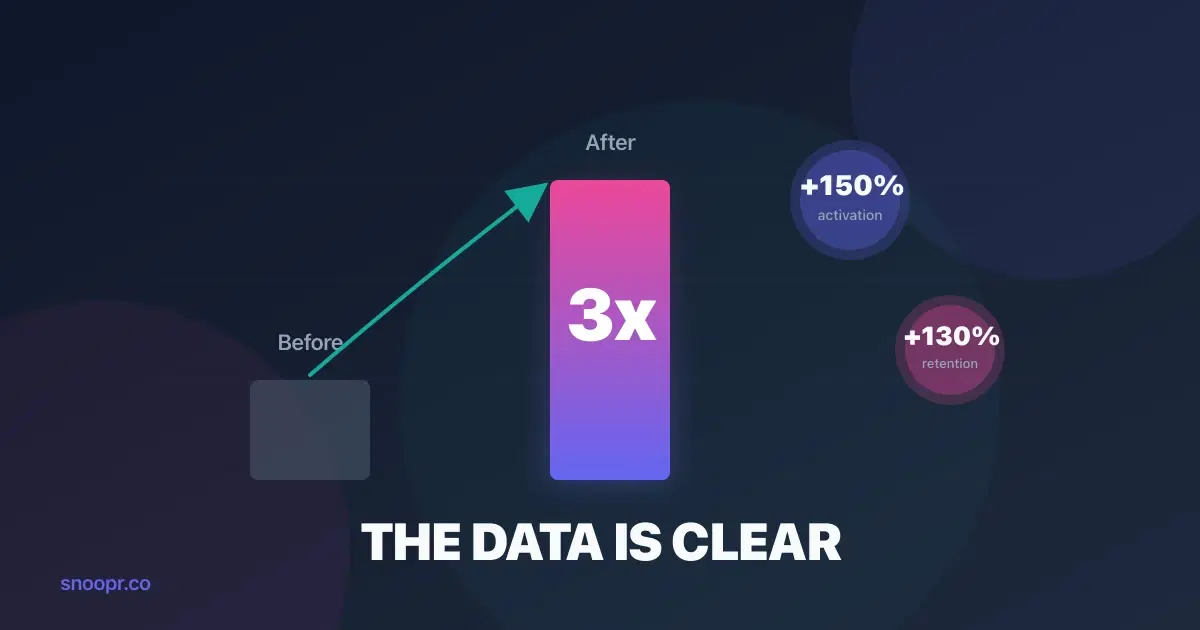
Yes—mobile app onboarding increases conversions by 21-150% when done well, with optimized flows driving 3x more paying customers and up to 130% higher retention. But here's what the headline stats won't tell you: bad onboarding is worse than no onboarding at all, and 72% of users will abandon your app if the process takes too long.
The difference between onboarding that converts and onboarding that kills your funnel comes down to one thing: how fast you can test what works for your specific users. This article presents the evidence—activation data, paid conversion stats, revenue impact, and the counter-arguments—so you can make an informed decision about whether onboarding is worth your investment.
Key Points
- Onboarding increases activation rates by 21-150% in documented case studies, with apps using onboarding seeing 41% higher engagement scores
- 82% of subscription trial starts happen on Day 0—making onboarding the single biggest lever for paid conversions
- Users who complete onboarding are 3x more likely to become paying customers
- But 72% of users abandon apps if onboarding requires too many steps—bad onboarding actively hurts conversions
- The apps that win aren't the ones with "better" onboarding ideas—they're the ones testing 10x more variations with tools like Snoopr
The Skeptic's Question
You've heard the advice before. "Onboarding is critical." "First impressions matter." "You need to show value fast."
But advice is cheap. What does the data actually show?
Maybe you've wondered:
- Does onboarding really move the needle, or is it just another best practice that sounds good in blog posts?
- Could onboarding actually hurt conversions by adding friction?
- Is the ROI worth the engineering effort?
These are fair questions. And the answers are more nuanced than most articles admit.
Let me walk you through what the research actually shows—the wins, the failures, and what separates onboarding that converts from onboarding that kills your funnel.
The Evidence: Does Onboarding Increase Activation?
Let's start with activation—the moment a user first experiences value in your app.
The Baseline Problem
Without effective onboarding, the numbers are brutal:
- 77% of users abandon apps within the first 3 days (Business of Apps)
- 80% of users delete apps because they don't know how to use them (UserGuiding)
- 90% of users churn if they don't understand product value within the first week (UXCam)
Most users aren't rejecting your product. They're rejecting their confusion about your product. That's a solvable problem.
What Happens When You Add Onboarding
Airship's 2024 data compared apps with and without onboarding campaigns:
| Metric | With Onboarding | Without Onboarding | Difference |
|---|---|---|---|
| Engagement score | 24% | 17% | +41% |
| Next-day return rate | 20% | 16% | +25% |
That's not a marginal improvement. Apps with onboarding see nearly half again as much engagement.
Case Studies: Activation Improvements
The case studies are even more compelling:
| Company | Before | After | Improvement |
|---|---|---|---|
| UX redesign case study | 40% activation | 80% activation | +100% |
| Appcues (own product) | Baseline | 2.5x activation | +150% |
| MYOB (using Appcues) | Baseline | +21% activation | +21% |
| The Rooms (using Userpilot) | Baseline | +75% activation | +75% in 10 days |
| Take (communication platform) | Baseline | +124% activation | +124% |
Sources: Medium, Appcues, Appcues
The pattern is consistent: optimized onboarding improves activation by 21-150%.
But here's what these case studies don't tell you: these companies didn't get these results on their first try. They tested. They iterated. They found what worked through experimentation.
That's where Snoopr changes the equation. Traditional mobile development limits you to ~17 onboarding experiments per year (each change requires app store review). With Snoopr's instant publishing, teams run 100+ experiments annually—finding winning approaches 5-10x faster.
Can Onboarding Increase Paid Conversions?
Activation is one thing. But does onboarding actually drive revenue?
The data says yes—decisively.
The Day 0 Window
RevenueCat's State of Subscription Apps 2025 revealed a critical insight:
82% of subscription trial starts happen the same day a user installs the app.
Not the first week. The first day. Often the first session.
This means your onboarding isn't just about teaching users how to use your app. It's about converting them to trial before they leave. The window is measured in minutes, not days.
Additional timing data:
- 68% of users decide whether to subscribe within three days of installation
- 70% of users churn within the first 24 hours if not properly engaged
- 80% of free trials convert on Day 1 of app use
Your onboarding IS your conversion funnel.
Paywall Timing: The 5.5x Difference
One of the most surprising findings from the research: where you place your paywall in onboarding matters more than what's on it.
Superwall's analysis found:
| Paywall Position | Trial-to-Paid Conversion |
|---|---|
| Upfront (before content) | ~12% |
| Delayed (after content) | ~2% |
| Difference | 5.5x |
Case studies confirm this pattern:
- FitnessAI: Moving paywall before onboarding increased paywall views by 50% and doubled install-to-trial conversions
- Rootd: Moving paywall to first two screens resulted in 5x revenue growth
- Greg app: Moving paywall from after first workout to before increased conversion from 3% to 15%
Sources: AppAgent, DEV Community
The conventional wisdom—"show value before asking for money"—may be exactly wrong for mobile apps. The data suggests showing your paywall early filters for intent and converts users while they're still engaged.
But here's the catch: what works for Rootd may not work for your app. The only way to know is to test. Snoopr lets you A/B test different onboarding sequences—including paywall placement—without engineering involvement or app store delays.
Revenue Impact: The Numbers
The revenue case studies are striking:
| Company | Change | Result |
|---|---|---|
| Travel app (Adapty) | Rebuilt onboarding | +102% ARPU, +30% conversion, +50% revenue |
| Mojo | Longform paywall (Japan) | +60% ARPU, +20% conversion |
| Rootd | Paywall moved to start | 5x revenue |
| Prime Fasting | Onboarding + paywall experimentation | $205k to $1M ARR in 3 months |
Sources: Adapty, RevenueCat
More than 50% of subscription app revenue is captured during onboarding for many apps. The onboarding experience isn't a nice-to-have—it's where most of your money is made or lost.
Users Who Complete Onboarding Convert at 3x the Rate
UserGuiding's research found that users who complete an onboarding checklist are 3x more likely to become paying customers.
Pendo's 2024 customer data shows similar patterns:
- UserTesting: Users who completed guided onboarding converted at 54.4% vs 4.5% for those who didn't engage (12x improvement)
- Cin7: Trialists who completed in-app tour were 75% more likely to convert to paying customers
The implication is clear: getting users through onboarding isn't just about education—it's directly predictive of revenue.
The Counter-Argument: When Onboarding Hurts Conversions
Here's what the "onboarding is essential" crowd won't tell you: bad onboarding is worse than no onboarding.
The Friction Problem
The data on onboarding friction is sobering:
- 72% of users abandon apps if onboarding requires too many steps (UserGuiding)
- Users are 3x more likely to abandon if registration requires more than 3 screens (MoldStud)
- 40% of users abandon on payment setup screens (Zigpoll)
- Poor onboarding causes up to 60% of users to drop off within the first week (AppsFlyer)
Case Study: When Friction Backfires
GrowthMentor documented what happened when they added a mandatory Typeform questionnaire to their onboarding:
Conversion rate dropped by over 80%.
Yes, they collected valuable user data. But they lost 4 out of 5 potential customers in the process.
The Time Constraint
Clutch's research found:
- 72% of users want onboarding completed in under 1 minute
- 28% of users feel frustrated when onboarding extends to 1.5 minutes
You have roughly 60 seconds before users start looking for the exit.
What This Means
The evidence doesn't say "don't do onboarding." It says "bad onboarding actively hurts you."
The apps that succeed don't guess what "good" onboarding looks like. They test relentlessly until they find flows that convert—then test more. This is why Snoopr focuses on iteration speed: the faster you can test, the faster you can move from "bad onboarding" to "optimized onboarding."
Is Onboarding Worth the Development Effort?
Given the evidence, the question shifts from "does it work?" to "is the ROI worth it?"
The Retention Multiplier
Braze's research shows the long-term impact:
| Onboarding Approach | 2-Month Retention Lift |
|---|---|
| Single push notification in first week | +71% |
| Multi-channel onboarding (push + email/in-app) | +130% |
Airship's data quantifies messaging frequency during onboarding:
| Notification Frequency | Retention vs. Zero Messages |
|---|---|
| Any message in first 90 days | +190% (nearly 3x) |
| Weekly messages | +440% |
| Daily messages | +820% |
The retention compound effect is massive.
The MRR Connection
Appcues quantified the revenue impact of activation improvements:
A 25% increase in activation leads to a 34.3% lift in MRR after 12 months.
This isn't linear—it compounds. Better activation → better retention → higher LTV → more revenue to reinvest in growth.
The Real Cost Calculation
The question isn't whether onboarding is "worth it." It's whether your current approach captures the available value.
Consider:
- Average app loses 77% of users in 3 days
- 80% of users delete apps because they don't know how to use them
- Users who complete onboarding are 3x more likely to pay
How much revenue are you leaving on the table with a suboptimal flow?
The answer almost always justifies the investment—but only if you can iterate fast enough to find what works. Building onboarding once and hoping for the best is not the same as systematically optimizing it.
Snoopr exists specifically for this: install the SDK once (~30 minutes), then product teams control the entire onboarding experience through a visual builder. No engineering queues. No app store delays. Test, learn, and improve at the pace of your ideas.
What Separates Onboarding That Converts from Onboarding That Kills
Based on the research, here's what differentiates high-performing onboarding:
Winners Get Users to Value Fast
The top-performing apps in every category share one trait: they demonstrate value before asking for anything.
- Show the core benefit in seconds, not minutes
- Delay account creation until after the first "aha moment"
- Request permissions contextually, not upfront
Winners Test Relentlessly
The case studies with 100%+ improvements didn't achieve those results with their first attempt. They tested:
- Different screen sequences
- Various headline framings
- Multiple paywall positions
- Personalized vs. generic flows
Userpilot's research found that personalized onboarding can increase retention by up to 70% within the first week. But you can't personalize effectively without testing what resonates with different segments.
Winners Measure Everything
High-performers track:
- Completion rates by step
- Time-to-activation
- Correlation between onboarding completion and paid conversion
- Drop-off points that predict churn
Without measurement, you're guessing. With data, you're optimizing.
The Iteration Gap
Here's the uncomfortable truth: most mobile teams can't test fast enough to find winning onboarding.
Traditional mobile development means:
- Every change requires engineering time
- Every change requires app store review (2-7 days)
- Every change requires waiting for users to update
At 3+ weeks per iteration, you run maybe 17 experiments per year.
Your competitor using Snoopr? They're running 100+ experiments annually. They're testing headlines, sequences, paywall positions, and personalization approaches while you're waiting for Apple's approval on your first change.
The winning apps aren't smarter. They're faster learners.
The Verdict: Does Onboarding Increase Conversions?
Yes—when done well.
The evidence is clear:
- Activation improves by 21-150% with optimized onboarding
- Paid conversions increase by 3-12x for users who complete onboarding
- Revenue grows by 50-500% in documented optimization case studies
- Retention improves by 130% with multi-channel onboarding
But the evidence is equally clear about the risks:
- 72% of users abandon if onboarding has too many steps
- Bad onboarding can drop conversions by 80%
- Most apps never find their optimal flow because they can't test fast enough
The apps that win aren't the ones with the best initial ideas. They're the ones that test, measure, and iterate until they find what converts.
If you're still treating onboarding as a "build once and forget" project, you're leaving substantial revenue on the table. If you're iterating continuously with tools that let you move fast, you're capturing value your competitors can't.
How to Apply This Data
If the research has convinced you that onboarding optimization is worth pursuing, here's how to start:
1. Measure your current state
What's your onboarding completion rate? Where do users drop off? What percentage of users who complete onboarding become paying customers?
Without baselines, you can't measure improvement.
2. Identify your biggest leak
The data suggests prioritizing:
- The first screen (sets the trajectory for everything)
- Paywall timing and positioning
- Steps with highest drop-off
3. Test one variable at a time
The case studies that show 100%+ improvements ran dozens of experiments. Start with your highest-impact hypothesis, test it, and build on what you learn.
4. Remove the iteration bottleneck
If testing a headline change takes 3 weeks, you'll never optimize fast enough. Snoopr lets you:
- Build onboarding flows visually (no code after initial SDK install)
- Publish changes instantly (no app store review)
- A/B test variations with proper statistical controls
- Iterate in days instead of months
The teams running 100+ experiments per year aren't working harder. They're using tools that remove the friction from testing.
FAQ
Does onboarding increase activation?
Yes—by 21-150% in documented case studies. Airship's 2024 data found that apps with onboarding campaigns see 41% higher engagement scores than apps without. Multiple case studies show activation improvements ranging from 21% (MYOB) to 150% (Appcues' own product). The key factor is optimization—generic onboarding shows modest gains, while tested and refined onboarding shows dramatic improvements. Snoopr enables the rapid testing needed to move from "generic" to "optimized."
Can onboarding increase paid conversions?
Yes—users who complete onboarding are 3x more likely to become paying customers, according to UserGuiding research. Pendo's customer data shows even more dramatic results: UserTesting saw 54.4% conversion for users who completed guided onboarding vs. 4.5% for those who didn't (12x improvement). The key insight from RevenueCat is that 82% of trial starts happen on Day 0—making onboarding the primary conversion driver for subscription apps.
Will onboarding hurt conversions?
Bad onboarding will, yes. UserGuiding data shows 72% of users abandon apps if onboarding requires too many steps. GrowthMentor documented an 80% drop in conversions after adding a mandatory questionnaire to their onboarding. The evidence suggests that poorly designed onboarding—too long, too many steps, too much friction—actively damages conversions. The solution isn't to skip onboarding; it's to test and optimize until you find flows that work. Snoopr makes this testing fast enough to be practical.
Is onboarding worth the development effort?
Yes, when you can iterate fast enough. The revenue data is compelling: Appcues found that a 25% improvement in activation leads to 34.3% higher MRR over 12 months. Case studies show 50-500% revenue improvements from onboarding optimization. But the ROI depends on your ability to test and improve—a single static onboarding flow captures far less value than one that's been optimized through dozens of experiments. The real question isn't whether onboarding is worth it, but whether your approach allows enough iteration to find what works.
How much does onboarding impact retention?
Multi-channel onboarding improves 2-month retention by 130%, according to Braze research. Airship data shows even more dramatic effects: users who receive any notification in their first 90 days have 190% higher retention than those who receive none. The first-week experience sets the trajectory for long-term engagement. Snoopr helps you optimize this critical window through rapid A/B testing of different onboarding approaches.
How do I know if my onboarding is working?
Measure completion rates, time-to-activation, and correlation with paid conversion. If fewer than 30% of users complete your onboarding, there's likely significant friction. If users who complete onboarding don't convert at meaningfully higher rates than those who skip it, your onboarding may not be delivering value. Track drop-off by step to identify specific problem areas. Snoopr provides built-in analytics to monitor these metrics and A/B test improvements.
Ready to see what optimized onboarding could do for your conversions?
Snoopr lets you test onboarding flows at 10x the speed of traditional development. Install the SDK once, then create, edit, and A/B test onboarding experiences through a visual builder—no engineering involvement, no app store delays.
Start Free Trial → — 30 days, full access, no credit card
Book a Demo → — See the visual builder and A/B testing in action
The data shows that onboarding increases conversions—but only if you can iterate fast enough to find what works. Your competitors are testing. Are you?