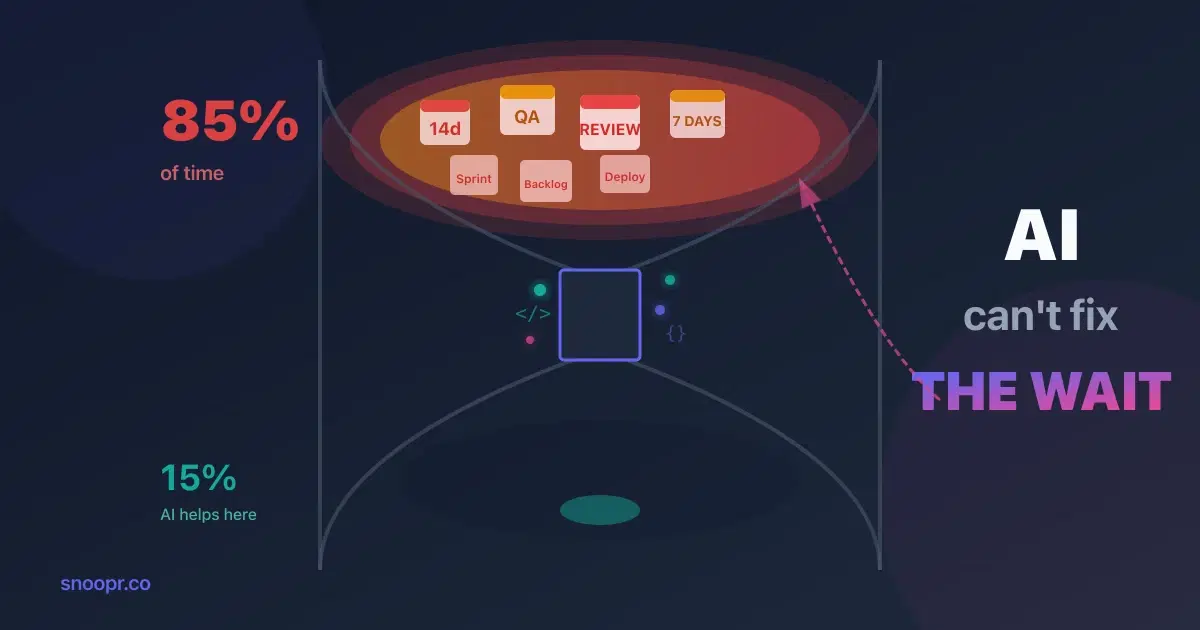
AI coding assistants won't fix your mobile onboarding bottleneck because the bottleneck was never about coding speed—it's about coordination, prioritization queues, and release cycles that exist entirely outside your IDE.
Your engineers might be shipping code 40% faster with Copilot or Cursor. That's real. But when you ask them to change a headline in your onboarding flow, you're not waiting on keystrokes. You're waiting on sprint planning, code review, QA cycles, and a 3-7 day app store review. AI made the smallest part of the process faster while leaving the actual bottleneck untouched.
This article explains why engineering dependencies in mobile onboarding persist in the AI era—and what actually solves them.
Key Takeaways
- AI coding assistants accelerate code writing, but code writing represents only 10-15% of the time between "onboarding change requested" and "change live in users' hands"
- The real bottleneck is the coordination layer: prioritization, context switching, code review, QA, and release cycles
- Mobile has a unique constraint web doesn't: every change requires app store review, adding 2-7 days that no AI can compress
- The solution isn't faster engineering—it's removing engineering from the onboarding loop entirely with platforms like Snoopr
The Promise vs. The Reality
GitHub Copilot. Cursor. Claude Code. Windsurf. The pitch is compelling: AI writes code faster, so everything ships faster.
And for certain tasks, it's true. Your engineers can scaffold a new component in minutes instead of an hour. Boilerplate evaporates. The cursor flies across the screen like magic.
So why does changing your onboarding headline still take three weeks?
Because you were never waiting on the code.
The Anatomy of a "Simple" Onboarding Change
Let's trace what actually happens when a product manager wants to update mobile onboarding. Say you want to change the first screen's headline from "Welcome to AppName" to "Get started in 60 seconds."
What AI optimizes (15% of total time):
- Writing the code change: 5-30 minutes
- With AI assistance: 2-10 minutes
What AI doesn't touch (85% of total time):
| Step | Time | AI Impact |
|---|---|---|
| Request enters backlog | 0-14 days | None |
| Sprint planning discussion | 1-3 days | None |
| Engineer context switches to task | 0.5-2 hours | None |
| Code review | 1-3 days | None |
| QA testing | 1-2 days | None |
| Merge and release branch prep | 0.5-1 day | None |
| App store submission | 0.5 hours | None |
| App store review | 2-7 days | None |
| Total | 7-30 days | ~15% faster |
You saved 20 minutes on a three-week process. The bottleneck didn't move.
Why Mobile Is Different From Web
Web teams using AI coding assistants actually do ship faster. Change a headline on your marketing site, push to main, and it's live in minutes. Vercel, Netlify, and similar platforms turned deployment into a non-event.
Mobile doesn't work that way.
Every change to your compiled app binary requires Apple and Google's permission. There's no "push to production" for mobile—there's "submit and wait." AI can't expedite App Store Connect. AI can't skip Google Play review. AI can't make TestFlight builds propagate faster.
This is the structural constraint that makes mobile onboarding uniquely dependent on engineering cycles. Web teams decoupled content from code years ago. Mobile teams are still hardcoding headlines into Swift and Kotlin files.
Snoopr exists specifically to break this constraint—separating onboarding content from your app binary so changes publish instantly without app store review.
The Coordination Tax
Even if app stores didn't exist, engineering dependencies would still bottleneck your onboarding iteration.
Here's why: engineers are a shared resource with competing priorities.
The prioritization queue problem:
Your onboarding change is competing with:
- Critical bug fixes
- Feature work for the product roadmap
- Technical debt paydown
- Infrastructure improvements
- Other teams' requests
A headline change rarely wins that prioritization battle. It sits in the backlog, waiting for a "quiet sprint" that never comes.
The context-switching cost:
When an engineer finally picks up your task, they need to:
1. Remember where the onboarding code lives
2. Understand the current implementation
3. Make the change
4. Test across iOS and Android
5. Handle edge cases they discover along the way
Studies show context switching costs 23 minutes of refocus time per interruption. Your "5-minute change" becomes a 45-minute task—and that's before code review.
AI coding assistants help once the engineer is in flow. They don't help the engineer get into flow, and they don't reduce the coordination overhead of getting the task to the engineer in the first place.
The Hidden Cost: Experiments You Never Run
The most expensive impact of engineering dependencies isn't the time you wait. It's the experiments you never run.
Consider: if every onboarding change takes three weeks end-to-end, how many experiments can you run per quarter? Maybe four, if you're aggressive.
Snoopr customers run that many experiments per week because changes publish instantly. The iteration gap compounds dramatically:
| Approach | Experiments/Quarter | Experiments/Year |
|---|---|---|
| Engineering-dependent | 4 | 16 |
| No-code platform | 48+ | 192+ |
After one year, the no-code team has 12x more learnings about what converts users. They've optimized headlines, screen order, imagery, and copy through rapid iteration. The engineering-dependent team is still guessing—or worse, has "optimized" based on four data points.
AI coding assistants don't change this math. They make individual changes slightly faster while leaving the total number of possible experiments roughly constant.
What Actually Solves the Bottleneck
The solution isn't faster engineering. It's removing engineering from the loop entirely.
This is what no-code mobile onboarding platforms do. Install an SDK once, then create and publish onboarding flows through a visual editor—no code changes, no app store reviews, no engineering tickets.
Snoopr was built specifically for this use case. The architecture:
1. One-time SDK integration: Engineers install the Snoopr SDK once (~30 minutes). After that, they're done.
2. Visual canvas editor: Product managers and marketers build onboarding flows in a Figma-like interface. Drag screens, edit copy, adjust styling—no code required.
3. Instant publishing: Click publish, and the change is live for all users immediately. No app store submission. No review wait. No release coordination.
4. AI content generation: Describe your app, and Snoopr's AI generates complete onboarding flows—headlines, body copy, CTAs—in seconds.
The result: onboarding iteration moves at the speed of thought, not the speed of sprint planning.
"But Our Engineers Could Build This"
A common objection: "We could build our own dynamic content system. With AI assistance, it would be even faster."
Technically true. Strategically wrong.
Building a dynamic onboarding system means:
- Architecting a content delivery mechanism
- Building a visual editor (or using JSON configs that only engineers can edit)
- Handling caching, versioning, and rollbacks
- Supporting A/B testing infrastructure
- Maintaining it as your app evolves
This is months of engineering time—time you could spend on your core product. And you'd still need engineers to manage the system, just at a higher level of abstraction.
Snoopr starts at $59/month. The build-vs-buy math isn't close.
The Right Role for AI in Mobile Development
AI coding assistants are genuinely valuable. They belong in your engineering workflow. But they solve a different problem than the one blocking your onboarding iteration.
Use AI coding assistants for:
- Core product features
- Complex business logic
- Performance optimization
- Infrastructure work
Use no-code platforms for:
- Onboarding flows
- In-app messaging
- Feature announcements
- Content that needs to change without releases
This isn't either/or. It's using the right tool for each job. AI helps engineers build better products faster. No-code platforms help product teams iterate on user experiences without engineering dependencies.
Snoopr handles the onboarding layer so your AI-assisted engineers can focus on what actually requires engineering.
Making the Shift
If you're currently dependent on engineering for every onboarding change, here's how to transition:
Step 1: Audit your onboarding change frequency
How many onboarding changes did you want to make last quarter? How many actually shipped? The gap reveals the cost of your current approach.
Step 2: Identify the bottleneck
Is it coding time, prioritization, review cycles, or app store delays? Usually it's all four, but knowing the distribution helps build the case for change.
Step 3: Calculate the experiment deficit
How many A/B tests could you run if changes were instant? Multiply by your average conversion improvement per test. That's the revenue you're leaving on the table.
Step 4: Evaluate no-code platforms
Snoopr offers a free trial. Install the SDK, build a test flow, and experience what instant publishing feels like. Most teams never go back.
FAQ
Can mobile app onboarding be done without engineering effort?
Yes—after a one-time SDK installation. Platforms like Snoopr separate your onboarding content from your app binary. Engineers install the SDK once (about 30 minutes), then product teams manage onboarding independently through a visual editor. Changes publish instantly without code modifications or app store reviews.
Why doesn't faster coding lead to faster onboarding iteration?
Because coding represents only 10-15% of the total time between requesting an onboarding change and seeing it live. The majority of time is spent in prioritization queues, code review, QA testing, and app store review—none of which AI accelerates.
How do mobile teams run more onboarding experiments?
By removing the engineering dependency. Teams using no-code onboarding platforms like Snoopr run 10-12x more experiments per year because changes publish instantly. More experiments mean more data, which means better-optimized onboarding and higher conversion rates.
Is building an internal dynamic onboarding system worth it?
Rarely. Building, maintaining, and iterating on a custom content delivery system requires significant engineering investment—typically months of work. Commercial solutions like Snoopr provide this infrastructure immediately, letting your engineers focus on your core product instead of reinventing onboarding tooling.
Mobile onboarding shouldn't wait on sprint planning. Snoopr gives product teams direct control over onboarding—publish instantly, iterate freely, no engineering required after initial setup.