Why Do Users Skip Mobile App Onboarding?
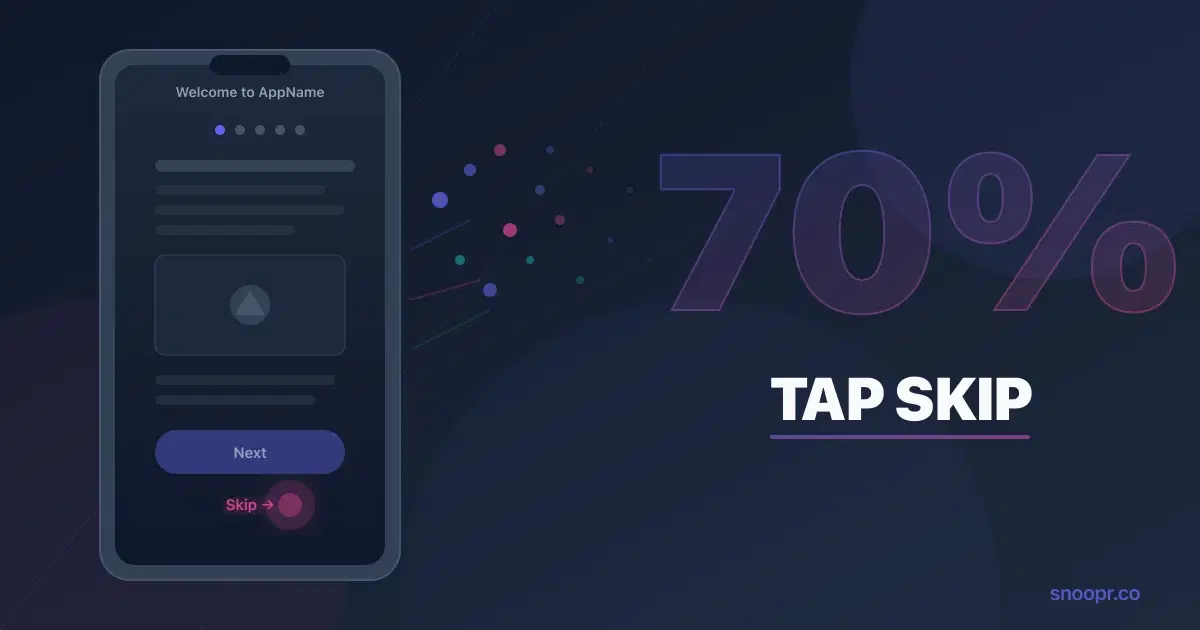
Users skip mobile app onboarding because it asks too much before delivering any value. Nearly 70% of users skip traditional, linear onboarding flows according to Chameleon's 2025 Benchmark Report analyzing over 550 million user actions—and the global onboarding completion rate after 30 days sits at just 8.4% (Business of Apps, Q2 2025).
That means for every 100 people who install your app, fewer than 9 will finish what you designed for them. The rest tap "Skip," swipe past your carefully crafted screens, or simply close the app and never return.
This isn't a design problem you can fix with better illustrations. It's a structural problem with how most mobile onboarding is built: too many steps, too many permission requests, too little value delivered too late. And because most teams hard-code their onboarding flows, testing fixes takes weeks of engineering time—so the problem compounds with every release cycle.
This article breaks down the seven specific reasons users skip mobile onboarding, what the research says about each one, and what you can do about it without waiting for your next app release.
1. There Are Too Many Steps
Every additional step in your onboarding flow costs you approximately 20% of your remaining users. This principle, first documented by former Google and Twitter product manager Gabor Cselle, has been validated repeatedly across mobile apps of all categories.
Chameleon's 2025 benchmark data puts hard numbers on it: 3-step onboarding tours see a 72% completion rate. Extend that to 7 steps, and completion collapses to 16%. That's not a gradual decline—it's a cliff.
The math is brutal. If 1,000 users start a 5-step onboarding flow and you lose 20% at each step:
- Step 1: 1,000 users
- Step 2: 800 users
- Step 3: 640 users
- Step 4: 512 users
- Step 5: 410 users
You've lost 59% of your audience before they reach the end. Add two more steps and you're down to 262 users—a 74% loss.
What this means for your app: If your onboarding has more than 5 steps, you're likely losing more users to the flow itself than to any product issue. The fix isn't better copy on screen six. It's eliminating screen six entirely.
With Snoopr, product teams can A/B test shorter onboarding variants in minutes—publish a 3-screen version alongside your existing flow, measure completion rates, and ship the winner. No engineering sprint required, no app store review delay. You get the data you need to cut the right steps, not guess at them.
2. You're Asking for Too Much Personal Information
Permission requests are one of the fastest ways to kill an onboarding flow. A 2025 GoodFirms survey found that 86% of mobile users avoid downloading apps that request too many permissions, and 43% will uninstall an app that asks for more data than they're comfortable sharing.
The numbers get worse when you dig into user sentiment:
- 73% of users say it bothers them when apps ask for data-collection permissions
- 58% worry that granting permissions compromises their data security
- Only 4.4% of users strongly agreed they were comfortable with apps accessing personal data
- 46% believe not all requested permissions are actually necessary for the app to function
Here's the critical insight: over 82% of users want a clear reason for each permission request before they grant it. Most onboarding flows don't provide one. They stack notifications, location, camera, contacts, and tracking permissions into the first 30 seconds—before the user has any reason to trust the app.
The fix isn't removing permissions—it's delaying them. Ask for permissions in context, when the user is about to use a feature that requires them. DoorDash, for example, delays registration entirely until the user places an order. Users can browse restaurants, view menus, and add items to their cart without signing up. This approach builds value before asking for trust.
With Snoopr, you can restructure your onboarding flow to front-load value and defer permission requests—then test whether the reordering improves completion rates. Change the sequence today, see the data tomorrow. No code changes, no release cycle.
3. Registration Walls Create Immediate Friction
Before users even see your onboarding content, many of them hit a registration wall—and never make it past.
Research from IPification shows that 43% of users abandon onboarding due to friction from identity verification and phone number verification. That's nearly half your users, lost before the first onboarding screen.
The authentication method matters enormously:
- 64% of users refuse to use SMS OTP authentication. SMS-based 2FA has only a 90% success rate, and nearly 50% of users have been permanently locked out of accounts due to SMS delivery failures.
- Mobile apps with one-click social login see 60% higher onboarding completion rates compared to traditional email/password registration (UserGuiding, 2026).
A seven-step KYC verification process at one fintech company caused 60% of users to abandon before completion (Userpilot). Seven steps. Sixty percent gone. Not because the product was bad—because the door was too hard to open.
What actually works: Reduce sign-up to the absolute minimum needed to start. Let users experience value first, then progressively collect information as they engage deeper. Every field you add to your registration form is a step in your onboarding flow—and every step costs you 20% of users.
Snoopr lets you design onboarding flows that start after whatever authentication method you use—but more importantly, it lets you test what information you collect at which point in the journey. Move your "complete your profile" prompt from screen 2 to screen 5, measure the difference, and iterate. That kind of sequencing test would normally require engineering to rebuild the flow. With Snoopr, it's a drag-and-drop change.
4. Users Prefer to Explore on Their Own
Not every user who skips your onboarding is frustrated. Some simply prefer to learn by doing.
40% of users prefer self-service over guided interaction when learning a new product (UserGuiding, 2026). And 74% of users prefer onboarding that adapts to their behavior and skips steps they already understand.
This creates a paradox: the users most likely to skip your onboarding—power users, tech-savvy early adopters, people who've used similar apps—are often the users most likely to convert. They don't need a walkthrough. They need your app to get out of the way and let them explore.
The problem is that most mobile onboarding treats every user identically. Chameleon's 2025 benchmark data revealed that only 18% of onboarding flows use any kind of personalization, despite 65% of tools collecting user data at signup. Teams are gathering the information needed to personalize—role, use case, experience level—and then ignoring it.
The data on personalization is unambiguous:
- Personalized onboarding flows see 65% higher completion rates than generic ones (Intercom)
- Tailored onboarding paths increase Day 30 retention by 52% (Design Studio UX)
- AI-powered personalized onboarding shows 70% churn reduction vs. static tours (UserGuiding)
What this means for your app: If you're showing the same 5-screen walkthrough to a first-time smartphone user and a senior product manager who's evaluated 10 competing tools, you're failing both of them. The first-time user needs more guidance. The PM needs less. One of them will skip—and you won't know which one, or why.
Snoopr's AI-powered flow generation lets you create multiple onboarding variants for different user segments in minutes. Build a detailed walkthrough for new users and a quick-start flow for experienced ones. Assign them based on the data you collect at signup. Iterate on each independently. No engineering coordination required.
5. Your Onboarding Teaches Features Instead of Delivering Value
Here's a finding that should make every product team uncomfortable: Nielsen Norman Group found that tutorials don't improve task performance. In quantitative usability testing, users who read mobile app tutorials were no more successful at completing tasks than those who skipped them.
Read that again. The users who sat through your tutorial performed no better than the ones who tapped "Skip."
This happens because most onboarding flows are designed as feature tours: "Here's button A. Here's how to use feature B. Tap here to access settings." They teach mechanics, not outcomes. And users don't care about mechanics—they care about solving the problem that made them download your app in the first place.
Former Google and Twitter PM Gabor Cselle put it bluntly: "Mobile app users are incredibly fickle—they can't be expected to step through layers of signup and registration." They downloaded your app to solve a specific problem. Every second you spend explaining your UI is a second they're not solving that problem.
The alternative is value-first onboarding. Instead of explaining features, help users accomplish something meaningful in the first 60 seconds:
- Duolingo doesn't explain how the app works. It drops you into a lesson immediately. Result: first-week churn decreased by 47%, 30% more users completed their first week of lessons, and satisfaction scores increased by 15%.
- DoorDash doesn't explain how to order food. It shows you nearby restaurants immediately.
The lesson: Your onboarding should be an experience, not an explanation. Show users what your app does for them by letting them do it—not by telling them about it.
With Snoopr, you can rapidly prototype and test value-first onboarding flows. Replace your feature tour with a guided first-action flow. Measure whether users who complete the new flow activate at higher rates. If it doesn't work, try another approach tomorrow. The speed of iteration is what makes the difference—not getting the first version right.
6. Forced Onboarding Backfires
The instinct to make onboarding mandatory is understandable: if users skip it, they'll miss important information and churn. But the data says the opposite.
User-triggered onboarding tours outperform auto-triggered (forced) tours by 2-3x in completion rates (Chameleon 2025). And skippable onboarding flows have 25% higher completion rates than mandatory ones (Petavue).
The most dramatic evidence comes from Vevo. In a controlled experiment with over 160,000 participants run over 28 days, Vevo removed their tutorial screens entirely and added a skip option. The results:
- Completed logins increased by 9.69%
- Completed sign-ups increased by 5.85%
- The number of users who actually skipped? No statistically significant change.
- Engagement and retention metrics? Unaffected.
Let that sink in. Vevo removed their onboarding tutorials, and virtually the same percentage of users engaged with the content—but significantly more users completed registration because the option to skip removed the feeling of being trapped.
Why forced onboarding fails: It triggers psychological reactance—the instinct to resist when you feel your freedom is being restricted. When users see a mandatory 5-screen walkthrough with no exit, they don't think "I should pay attention." They think "How do I get past this as fast as possible." They tap through without reading. They've technically "completed" onboarding, but they haven't absorbed anything.
What works instead: Make onboarding available but optional. Use progress indicators—they improve completion by approximately 12% (Chameleon 2025). Gamify the experience: LinkedIn's progress bar increased profile completion by 55%. Shine, a fintech app, achieved 80% onboarding completion vs. the 15% industry average using gamification elements. Talana saw a 40% increase in activation rates with a gamified checklist and visual progress indicators.
Snoopr gives you the flexibility to test both approaches. Launch a mandatory flow and an optional one side by side. Add a progress bar to one variant. Include a "Skip for now" button on another. Within days, you'll have the data to prove which approach works for your specific users—not someone else's users, yours.
7. You Can't Iterate Fast Enough to Fix It
This is the reason that compounds all the others.
Maybe you already know your onboarding has too many steps. Maybe you've seen the drop-off data. Maybe your PM has a backlog of onboarding improvements that keep getting deprioritized behind feature work.
The problem isn't awareness. It's velocity.
Up to 67% of all customer churn happens during onboarding when issues aren't resolved early (OnRamp). Customers who experience poor onboarding are 3x more likely to churn within the first year and 67% less likely to expand their usage (HustleX, 2025). The churn rate reaches 71% within 90 days for apps with friction-heavy onboarding (MoEngage).
Every week you wait to fix a broken onboarding flow, you're losing users who will never come back. 80% of users who don't complete onboarding disappear after Day 1 (Userpilot).
And here's the compounding problem: most mobile teams can only ship onboarding changes every 2-4 weeks because every update requires engineering work, QA, and an app store review. That means you get 12-24 iterations per year on the single most important user experience in your app.
Compare that to what the data says works. Duolingo's 47% churn reduction didn't come from one brilliant redesign. It came from relentless experimentation. Shine's 80% completion rate didn't emerge from a single brainstorm. It came from testing and refining.
The teams that win at onboarding aren't smarter. They iterate faster.
Snoopr was built to solve exactly this problem. Install the SDK once, and your product team controls onboarding from a visual dashboard. Change a headline in 30 seconds. Rearrange screens with drag-and-drop. Publish instantly—no code changes, no app store review, no waiting. Run multiple variants simultaneously and let the data tell you what works.
The difference between 12 iterations per year and 12 per week isn't incremental. It's the difference between guessing and knowing.
What the Best Apps Do Differently
The apps with the highest onboarding completion rates share three patterns:
1. They keep it short. E-commerce apps work best with 2-3 steps. Social apps can tolerate 5-7 steps if value is delivered along the way. No category benefits from more than 7 steps.
2. They personalize. The 18% of apps that personalize onboarding dramatically outperform the 82% that don't. Even simple segmentation—new vs. returning user, beginner vs. advanced—makes a measurable difference.
3. They iterate constantly. The apps with the best onboarding aren't the ones that got it right on the first try. They're the ones that can test a new version every week instead of every quarter.
If fewer than 40% of your sign-ups hit their first key action within 24 hours, your onboarding is likely too complex (Plotline). And if you can't test a fix within days, the problem will persist for months.
Frequently Asked Questions
What percentage of users actually skip mobile app onboarding?
Nearly 70% of users skip traditional, linear onboarding flows, according to Chameleon's 2025 Benchmark Report analyzing over 550 million user actions. The global onboarding completion rate after 30 days is just 8.4% (Business of Apps, Q2 2025), meaning over 90% of users never finish all onboarding steps. The exact skip rate varies by app category—finance, health, and sports apps see the highest Day 1 completion at around 26%, while food and travel apps see significantly lower rates.
What are the most common onboarding mistakes that cause users to skip?
The most common mistakes are: (1) too many steps—completion drops from 72% at 3 steps to 16% at 7 steps; (2) excessive permission requests upfront—86% of users avoid apps that ask for too many permissions; (3) registration walls before delivering value—43% abandon during identity verification; (4) generic flows that don't adapt to user type—only 18% of flows personalize despite 65% collecting data; and (5) feature-focused tutorials instead of value-first experiences—NNGroup research shows tutorials don't improve task performance.
When does onboarding actually backfire?
Onboarding backfires when it's mandatory, too long, or feature-focused rather than value-focused. Forced onboarding triggers psychological reactance—users tap through without reading. Vevo's 160,000-participant study showed that removing tutorials increased logins by 9.69% with no negative impact on engagement. Onboarding also backfires when it delays the user's first moment of value: if users form opinions within 180 seconds and your onboarding consumes 120 of those seconds explaining buttons, you've left almost no time for them to experience why your app matters. Snoopr helps teams avoid these pitfalls by enabling rapid testing of different onboarding approaches—so you can find what works before a bad flow costs you thousands of users.
How do I fix onboarding skip rates without a full redesign?
Start with three high-impact changes you can test quickly: (1) cut your flow to 3-5 steps maximum—every step you remove saves approximately 20% of users; (2) make onboarding skippable and add a progress indicator, which improves completion by ~12%; (3) move permission requests out of onboarding and into contextual moments when users actually need those features. With a no-code onboarding platform like Snoopr, you can make all three changes and publish them today—no engineering work, no app store review. Test the new flow against your current one and let the data decide.
Ready to find out why your users are skipping onboarding—and fix it?
Snoopr lets you build, test, and iterate on mobile onboarding flows without code or app store reviews. Install the SDK once, then create shorter flows, test skippable vs. mandatory, personalize by segment, and publish changes instantly—all from a visual builder.
Start Free Trial → — 30 days, full access, no credit card
Book a Demo → — See the visual builder and A/B testing in action
The data says 70% of users skip onboarding. The question is whether you can iterate fast enough to change that number. Your competitors are testing. Are you?